THE MOVE & MYTH REVIEW
Furi
A striking procession of duels that gives each opponent enough space to become both a mechanical lesson and a memorable dramatic presence.

Game facts
- Developer
- The Game Bakers
- Publisher
- The Game Bakers
- Released
- 5 July 2016
- Platforms
- Windows (Steam edition)
- Model
- Paid game
- PEGI
- 16 · Violence, Bad Language — Steam UK listing
- Players
- Single-player
- Length
- Short
- Difficulty
- 5 / 5 · Demanding
- Edition
- Base game (Steam)
Edition: Base game (Steam)
The score, explained
The interest and responsiveness of the core decisions and actions.
How progression, exploration and goals fit together.
The coherence of the visual, musical and narrative presentation.
How clearly the game explains its rules and offers useful ways to engage.
The depth of optional goals, alternative approaches and reasons to return.
Give the duel the stage
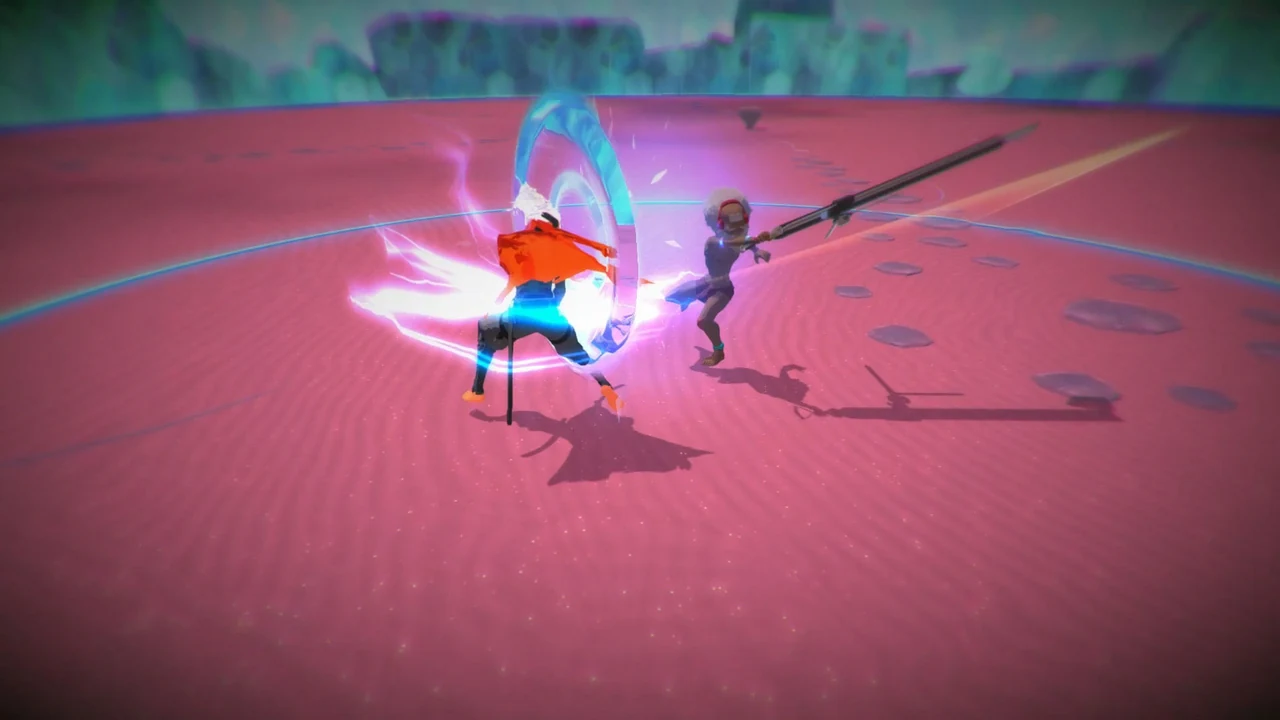
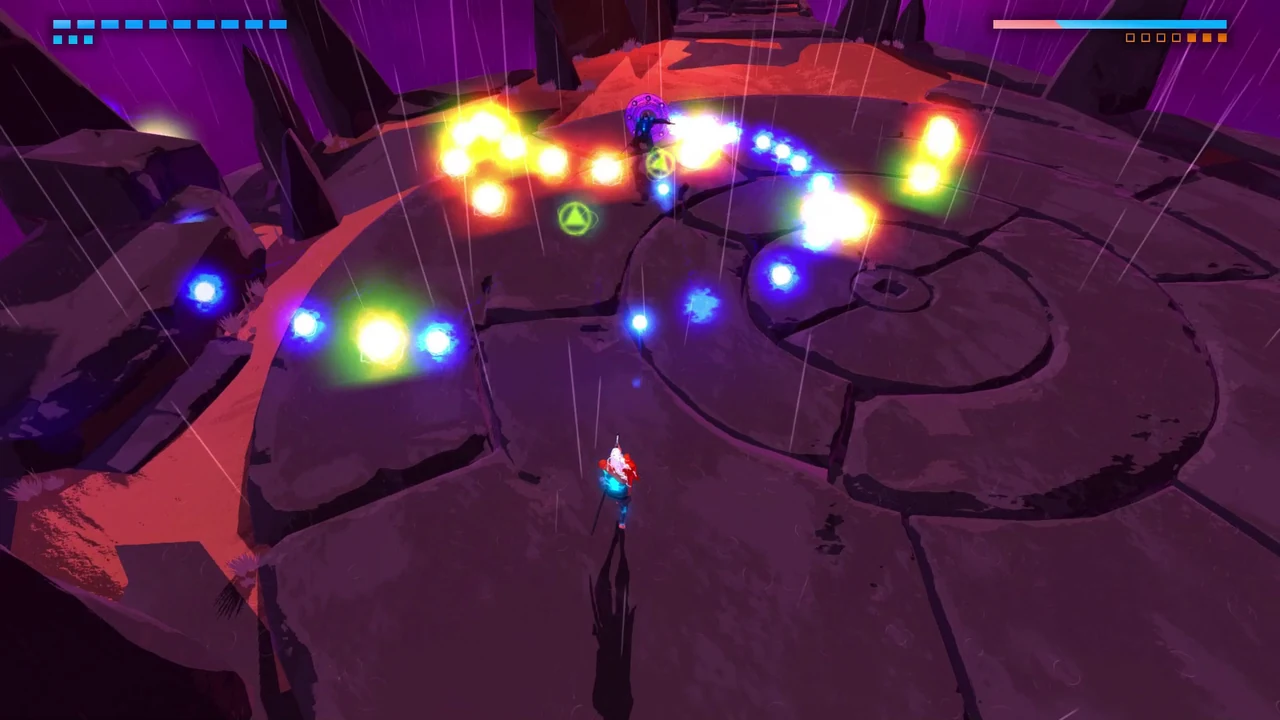
Furi builds its escape around a succession of opponents, allowing each confrontation to occupy the space that another adventure might divide among travel, equipment and incidental combat. The character moves between encounters, but the main event is the changing relationship with the adversary ahead. Ranged projectile patterns and close sword exchanges require different kinds of attention, giving a fight several rhythms rather than one continuous demand for speed. Move & Myth values that concentration. An opponent is not simply a larger obstacle placed at the end of a level. Their appearance, music and phases define a substantial part of the journey. The game asks the player to know a confrontation closely enough that its dramatic escalation can also become a readable sequence of practical decisions about movement, timing and the moment to answer pressure with an attack.
Let the opponent change the space
The shift between distant and close combat is especially important to the design. A wide pattern asks you to navigate the arena, while a sword exchange draws attention to a more immediate signal and response. Moving between those modes keeps the opponent's identity active across different kinds of challenge. The audiovisual presentation supports that identity without requiring a large surrounding world to establish it. We value how little the game needs to add before a new confrontation feels distinct. A different rhythm, pattern or visual presence can change the entire event because the player is already paying close attention to the duel. That economy makes success feel like understanding a particular adversary, rather than merely applying a sufficiently upgraded character to another broadly interchangeable battle with a higher demand for damage.
There is little room to postpone
A concentrated boss sequence offers few diversions when one fight becomes a wall. You cannot assume that a long exploration route or a new equipment build will provide another kind of progress while the timing remains unfamiliar. Reaching a difficult later phase may also mean repeating earlier phases that no longer contain much uncertainty. That rehearsal is enjoyable only if the duel itself remains interesting. The quieter passages between encounters provide mood and context, not an extensive alternative activity. Our Short band captures this focused structure rather than the number of attempts any player will need. Choose Furi when repeated contact with one opponent sounds like the point of the evening. A high score cannot make that format suitable for someone who wants their action embedded in a world full of independent routes and discoveries to pursue instead.
Learn the change of tempo
Choose Furi if a memorable opponent is enough to organise a session around. Separate the tasks of reading a projectile field and recognising a close-range attack, then notice what the transition between them demands. Conserving attention through a familiar phase can be as useful as trying to finish it more aggressively. Sekiro offers a related emphasis on precise responses but adds stealth, traversal and a larger setting around the practice. Furi is the more theatrical distillation. It suits someone who enjoys an encounter becoming clearer through repeated contact, with the music and visual identity helping that repetition remain distinctive. The satisfying outcome is not simply surviving the final attack. It is reaching a point where the opponent's changing performance makes sense and your own responses have begun to form a coherent answer to it.
The verdict
A striking procession of duels that gives each opponent enough space to become both a mechanical lesson and a memorable dramatic presence.
Reasons to play
- Alternating combat modes give encounters varied rhythms
- Distinct adversaries make the progression memorable
- The restrained structure keeps attention on the duel
Reasons to think twice
- Few alternative activities soften a difficult encounter
- Later phases may require repeating familiar earlier material
See the game
Assist & accessibility
Explore the available settings and control options on the official game page before choosing your setup.
Parents’ guide
Players: Single-player. No in-game purchase marker in the checked Steam listing. Separate downloadable content may be sold.
Age classification: 16. Violence · Bad Language Steam UK listing
Official sources
Reviewed: November 2026
You might also like
 Sekiro: Shadows Die Twice - GOTY EditionRead review →
 CelesteRead review →
 SifuRead review →